


Kindergarten
At the Kindergarten of the German School Nairobi, learning begins with curiosity, play, and a sense of wonder. For many children aged between 18 months and six years, this marks the start of a new chapter in their lives: taking their first steps towards independence and discovering the world around them.
We support every child with care and attentiveness, building confidence and nurturing social and emotional skills. In our bilingual environment, children from diverse cultural backgrounds meet, learn from one another, and discover the value of communication, empathy, and respect.
Up to 124 children learn and play in seven thoughtfully designed groups, guided by German and English speaking educators who work closely together to create a warm, age appropriate, and trusting atmosphere. Learning takes place through engaging projects that combine movement, music, art, books, and nature, with plenty of space for participation, creativity, curiosity, and play.
Three uniquely designed playgrounds invite children to explore and be active, while a cosy sleep room for our younger children and a sensory motor room provide calm spaces for rest and relaxation. On Fridays, children enjoy Nature Day, spent in the nearby Karura Forest, in our school garden, or in our mud kitchen, where learning comes alive through hands on experiences.
Nora Olbert
Head of KindergartenIdah Wangechi
Stellvertretende KindergartenleitungOur Learning Programme
Our educational programme is shaped by the four core values of our school.
Trust
Supporting Children’s Growth
- Self Awareness and Confidence
- Social Skills
- Understanding the World
- Learning How to Learn

Belonging
Our Educational Approach
- Observing and Celebrating Children’s Development
- Creating Meaningful Daily Routines
- Thoughtfully Designed Spaces and Materials
- Inclusive Learning for All Children
- Supporting Children Through Transitions

Responsibility
Understanding a Child’s World
- Seeing the World Through the Child’s Eyes
- Growing Within a Community
- Discovering the World Around Us
- Learning to Care and Make a Difference

Realization
Our Partnership with Families
- Open and Respectful Communication
- Parent Information Evenings
- Parents Council
- Individual Progress Meetings
- Community Events
- Active Participation
Our Curriculum
Our curriculum is based on play, curiosity, and discovery. Children learn through active participation and by gaining meaningful experiences through their senses. Each child is encouraged to explore, experiment, and learn in their own individual way. Through holistic projects, we connect everyday life with mathematics, science, music, art, history, and much more. This integrated approach supports language development, creativity, physical activity, and positive social interaction. For more information, please see our Learning Areas and Project Work.
Areas of Learning
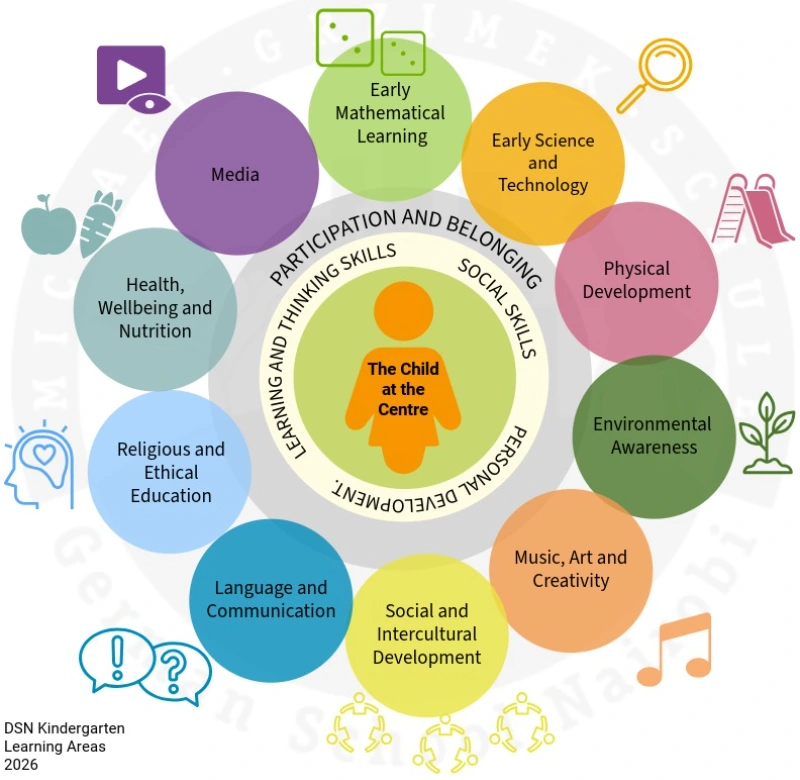
Here is an example of a diagram of the Areas of Learning.
- Lernen
„Kinder lernen, wie man lernt.“ Dafür brauchen sie stabile Beziehungen und verlässliche Interaktionen, die Vertrauen schaffen und Orientierung geben.
- Lernstrategien entwickeln
- Individuelles Lernen ermöglichen
- Lernprozesse begleiten und stärken
- Kooperation und Teamarbeit erleben
- Selbstständigkeit entwickeln
- Verantwortung übernehmen
- Sprache und Kommunikation (Medien)
Sprache ist Ausdruck und Gestaltungsform. Sie entwickelt sich durch Beziehung, Vorbilder und aktives Mitmachen. Kinder brauchen sprachlich sichere Bezugspersonen, um eine tragfähige Sprachgrundlage aufzubauen.
- Sprachliche Bildung: zuhören, sich verständlich ausdrücken, aktiv teilnehmen, erzählen, philosophieren, Reime und Gedichte entdecken
- Sprachvielfalt als Ressource und Ziel: in den Austausch treten, Erlebnisse und Gefühle teilen
- Zeichenwelten verstehen: Piktogramme, Symbole, Flaggen, Buchstaben und Zahlen
- Hineinwachsen in die Schriftkultur: Laute, Silben, erste grammatische Strukturen und ihre Schriftzeichen entdecken
- Entwicklung von Medienkompetenz: bewusster Umgang im Familienalltag und kindgerechte Nutzung als Lernressource
- Soziale und interkulturelle Bildung
„Kinder brauchen Wurzeln und Flügel“ sagte Johann Wolfgang von Goethe. Wurzeln, um zu wissen, wo sie herkommen, und Flügel, um die Welt zu entdecken. In vertrauensvollen Beziehungen entwickeln Kinder ein positives Selbstbild, erleben sich als individuelle Persönlichkeit und als Teil einer Gemeinschaft.
Diese Erfahrungen entstehen in der Familie sowie in einem sozialen und kulturellen Umfeld, das unterschiedliche Lebensformen, Werte, Traditionen, Grundrechte und Glaubensrichtungen umfasst.
Kinder lernen:
- sich selbst und andere in Beziehung wahrzunehmen
- respektvoll und achtsam miteinander umzugehen
- Lob und Kritik anzunehmen
- Gefühle wahrzunehmen und auszudrücken
- Konflikte zu lösen und Gemeinschaft aktiv mitzugestalten
- Regeln zu verstehen und anzuwenden
- eigene Leistungen realistisch einzuschätzen
- Gesundheit und Bewegung
Eine gesunde Balance aus Ernährung, Bewegung und Körperwahrnehmung ist zentral für die kindliche Entwicklung.
- den eigenen Körper kennenlernen
- ein Verständnis für gesunde Ernährung entwickeln
- tägliche Bewegung drinnen und draußen erleben
- Naturwissenschaftlich technische Bildung
Kinder experimentieren, forschen und entdecken. Sie erleben die vier Elemente, untersuchen Materialien und setzen sich mit naturwissenschaftlichen Phänomenen auseinander.
- Mathematische Bildung
Im spielerischen Umgang mit Zahlen und Mengen lernen Kinder:
- zählen, ordnen und sortieren
- einfache Rechenprozesse verstehen
- Formen erkennen, vergleichen und benennen
- Musisch ästhetische Bildung
Kinder erleben Kunst und Musik als festen Bestandteil ihres Alltags.
- singen, Musik hören und selbst Musik machen
- malen, basteln, formen und gestalten
- verschiedene Materialien und Werkzeuge kennenlernen
- zwei und dreidimensional gestalten
- Künstlerinnen, Künstler und ihre Werke entdecken
- Inspiration für Bewegung, Ausdruck und Kreativität finden
- Ökologische Bildung
Kinder setzen sich aktiv mit ihrer Umwelt auseinander.
- Natur mit allen Sinnen erleben
- Pflanzen und Tiere kennenlernen
- ökologische Zusammenhänge verstehen
- eigene und andere Kulturen entdecken
Beobachtung und Dokumentation
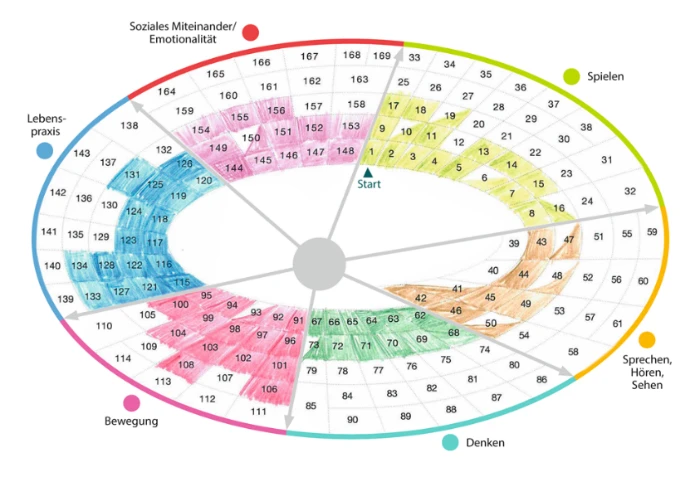
Unser Beobachtungsinstrument ist die Entwicklungsschnecke von Kornelia Schlaaf Kirschner. Sie ist eng mit unseren Bildungsbereichen verknüpft und unterstützt eine ganzheitliche Sicht auf die Entwicklung jedes Kindes.
 X
XProject-based Learning
 Weekly schedule
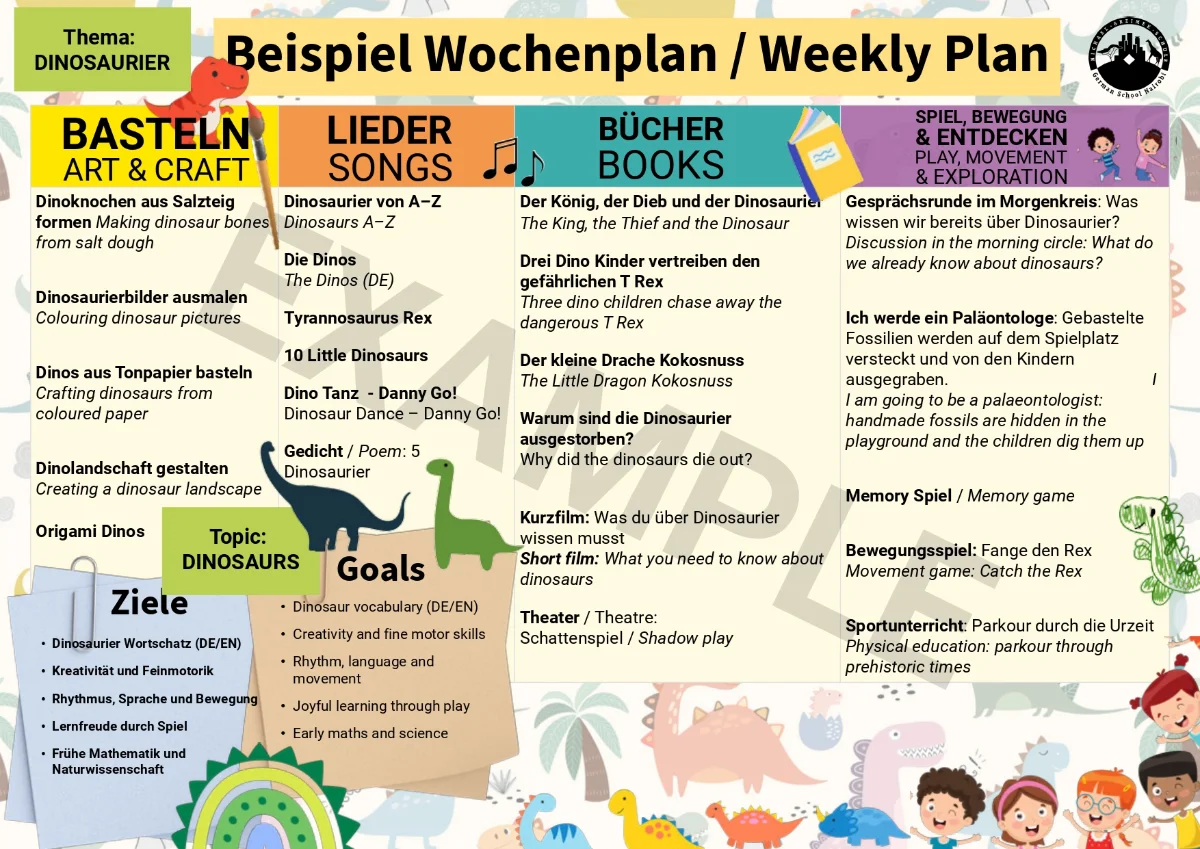
Learning takes place through a holistic, project-based approach. Projects usually run for one to three weeks and are implemented both in the nursery and kindergarten sections. Each project grows out of the children’s interests, needs, and the dynamics of the group. Through active participation, children help shape the direction of the project, making learning meaningful and engaging.
Every project connects everyday topics with specific learning areas such as mathematics, science and physics, music, art, history, literature, excursions, and many other subjects. These are playfully woven into one central theme.
The focus is on creating rich sensory experiences and hands-on learning opportunities that support each child’s development in a natural and age-appropriate way. This approach helps children feel part of a community while nurturing curiosity, creativity, language development, movement, and social skills.
Focus areas within each project include:
- Exploring and developing a central theme
- Sports and movement
- Music and rhythm
- Art and creative expression
- Mathematics and literature
- Experimenting and early physics
- Language Development including German as a foreign language
Das Lernen erfolgt spielerisch und in thematischen Projekten, die über ein bis drei Wochen laufen. So werden Neugier, Kreativität und entdeckendes Lernen auf natürliche Weise gefördert.
Projektthemen sind unter anderem:
- Sports and movement
- Music and rhythm
- Art and creative expression
Darüber hinaus genießen die Kinder regelmäßige Lesezeiten in der Bibliothek und übernehmen Verantwortung, indem sie die Schulhasen füttern und versorgen.
Jeden Freitag ist Naturtag im Karura Forest: ein Tag zum Entdecken, Spielen und Lernen in der Natur mit allen Sinnen.
Daily Schedule
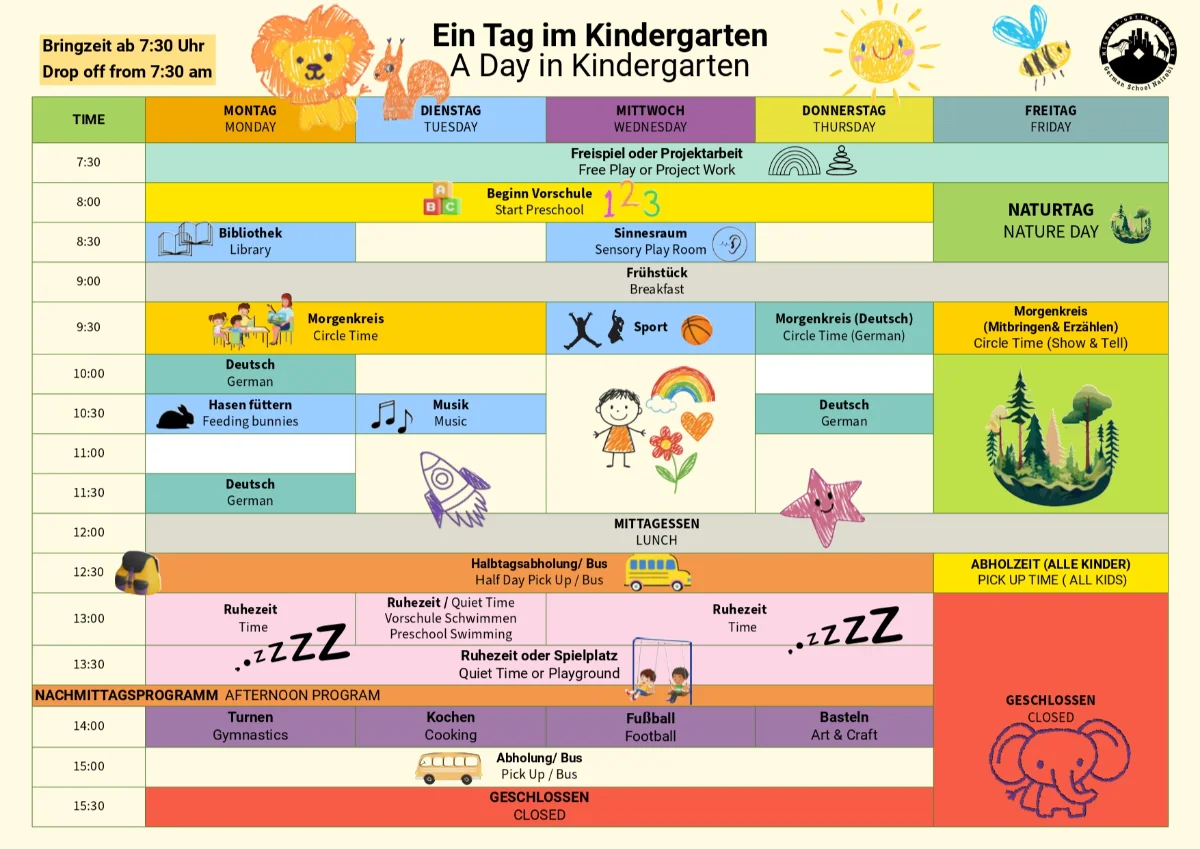 TIMETABLE KiGa
A clear daily routine gives children a sense of security and orientation. Fixed elements such as morning circle, shared breakfast, project time, outdoor play, and quiet moments structure the day and create a familiar and reassuring framework.
Our doors are open from 7:30 am to 3:30 pm geöffnet, and on Fridays from 7:30 am to 1:00 pm..
Within this balance of movement, play, and relaxation, children are encouraged to find their own rhythm. They are free to be active and loud, to explore and discover, to retreat and rest, or simply to observe. This creates a well-balanced day in which every child can learn and grow at their own pace.
Within the weekly routine, our pre-school programme, die , German language support , and group project work are integrated naturally into everyday Kindergarten life. In addition, children enjoy weekly activities such as a sports session in our gym, a music lesson in our music room, and reading time in the library. They also take on responsibility by helping to feed and care for the school bunnies.
Every Friday is Nature Day
New to our concept: Once a month, the Kindergarten offers a “Open Groups Day” on a Friday for two hours. Accompanied by their key teachers, children are free to explore activities beyond their own group.
In addition to our sensory and motor skills room, our music room and our library the Kindergarten group rooms are transformed around a special theme, for example into a theatre space, discovery and experiment room, craft room, construction area, board game room, and much more.
Children decide for themselves how long they would like to stay in an activity and are free to move between activities.
This approach encourages flexibility, independence, and communicationIt allows children to follow their own interests and needs beyond their usual group, to engage with new peers and adults, and to gain new perspectives.
German as a foreign language
Our language programme promotes multilingualism as a valuable skill and helps children experience language as a bridge between cultures.
Our educators are qualified in German as a foreign and second language and respond carefully to the individual language needs of each child. Children encounter the German language every day as part of their Kindergarten routine through our pedagogical OPOL approach One Person One Language.
Additional German language support takes place several times a week within the groups, both in small group settings and during a special German focused morning circle. Pre school children receive further support twice a week in small groups. All language provision is coordinated by our German as a Foreign Language and Pre School Coordinator.
Learning is playful, interactive, and engaging. Children learn through movement, hands on experiences, and all their senses, supported by songs, games, stories, and meaningful opportunities to use language.
Close cooperation with the Primary School ensures a smooth transition to the next stage of learning. From Class 1 onwards, our curriculum is taught primarily in German.
Nature as a place for learning and experiencing
Nature plays a central role in the Kindergarten at the German School Nairobi. It provides children with an inspiring environment where they can play, explore, and learn. Through engaging with plants, animals, and natural materials, children naturally develop motor, sensory, social, and emotional skills.
Once a week, a special Nature Day takes place. Two groups go on an excursion to Karura Forestwhere they observe forest animals, learn about plants, and experience nature with all their senses. Two further groups spend time in our school garden discovering how vegetables and fruit are grown. At the same time, two groups explore our mud play area, where they experiment with natural materials and enjoy hands-on experiences.
This creates a day full of discovery, play, and learning in nature.
Nature Day also regularly takes place on the school grounds. During these sessions, children craft, play, and learn with natural materials, always with the aim of developing mindfulness, environmental awareness, and a sense of responsibility for the natural world.
Outings and Celebrations
Kindergarten excursions are a valuable extension of everyday learning and much more than just a day away from the classroom. They bring learning to life and allow children to gain new experiences, spark their curiosity, and explore the world around them in meaningful and varied ways.
Excursions support not only cognitive development, but also strengthen social and emotional skills. Children actively engage with their environment and experience connections between culture, history, and everyday life. In this way, they learn to see the world from different perspectives.
As part of targeted preparation for upcoming projects or Nature Day, group excursions take place regularly. These include visits not only to Karura Forest and Mlango Farm, but also to a wide range of learning locations across Nairobi, such as the Railway Museum, the National Museum, Apollo Science Park, Safari Walk, the Giraffe Centre, and many other educational sites. The costs of these excursions are shared in cooperation with parents.
In addition to excursions, celebrations and events also play an important role in strengthening our sense of community. They are an integral part of Kindergarten life and the wider school community. Whether birthdays, seasonal celebrations, or cultural festivities, these moments create special experiences, bring people together, and leave lasting impressions.
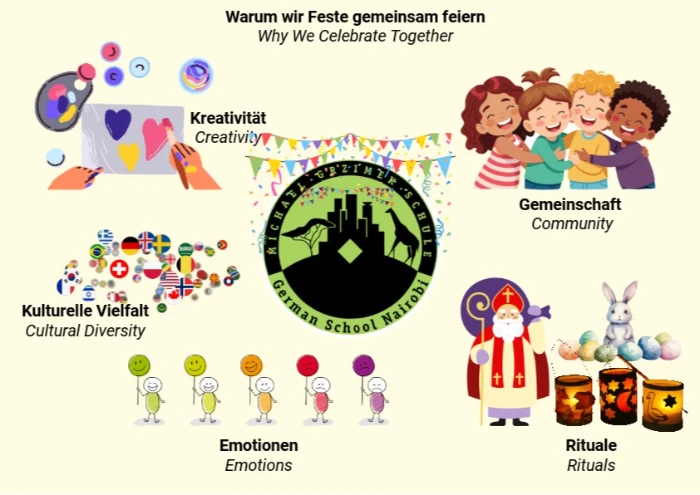
But why are these moments so meaningful for children?
- Strengthening community and togetherness
Celebrations create shared experiences that connect children. They learn to celebrate together, to be considerate of one another, and to enjoy special moments as a group. This strengthens a sense of belonging.
- Experiencing rituals and structure
Recurring celebrations give children security and orientation. Whether it is Easter, the lantern festival, or a Christmas celebration, rituals provide stability and help children understand the rhythm of the year.
- Developing social and emotional skills
Through celebrations, children experience joy, excitement, and sometimes disappointment, for example when it is not their own birthday. They learn to recognise, express, and share emotions with others.
- Building cultural awareness
Celebrations offer wonderful opportunities to learn about different cultures and traditions. Children experience diversity first hand and develop respect and understanding for one another.
- Encouraging creativity and participation
Celebrations are often accompanied by crafts, songs, dances, or theatre performances. These activities nurture children’s creativity and give them the opportunity to actively contribute.
For this reason, we often invite parents to join us in our celebrations, not only to support us, but to experience this sense of community together. In this way, our community at the German School Nairobi continues to grow, celebrating diversity and valuing each child as an individual within the group.

Pre-School – The Bridge to Primary School
In the final year of Kindergarten, the pre-school programme prepares children for their transition to Year 1. Our aim is to support each child individually and to provide them with the essential skills for a successful start at school – emotionally, socially, physically, linguistically, and cognitively.
Pre-school sessions are led either by the group’s German-speaking educators or together with the Pre-School and German as a Foreign Language (DaF) Coordinator in mixed groups. The Primary School leadership team also visits regularly and introduces playful first learning experiences. Through play-based learning, projects, and hands-on activities, children are gently introduced to letters, numbers, logical thinking, and social interaction.
The focus is on building confidence, concentration, curiosity, and joy in learning. Children learn to take responsibility, listen, express themselves, and find their place within a group.
Regular observations and close collaboration with the Primary School help us support each child according to their individual needs. Towards the end of the year, a school readiness assessment takes place to ensure that the transition to Primary School is as smooth and well supported as possible.
Classrooms & Surroundings


Our Co-curricular Activities
Our Kindergarten offers a varied afternoon programme every day from 2:00 to 3:00 pm The co-curricular activities rotate throughout the school year, ensuring that each group has the opportunity to take part in all activities.
Led by early years educators and specialised coaches, the activities complement the morning project work. They encourage community, creativity, and movement, and help children discover and develop their individual interests and talents.
Examples of Kindergarten activities include:
Tennis, football, basketball, movement, music, art, theatre, dance, crafts, and cooking.


